The real map
The traffic separation scheme between Larak and Musandam, the Tunbs, Kharg, Ras Tanura, Fujairah and Yanbu. Every lane is checked against real coastlines.
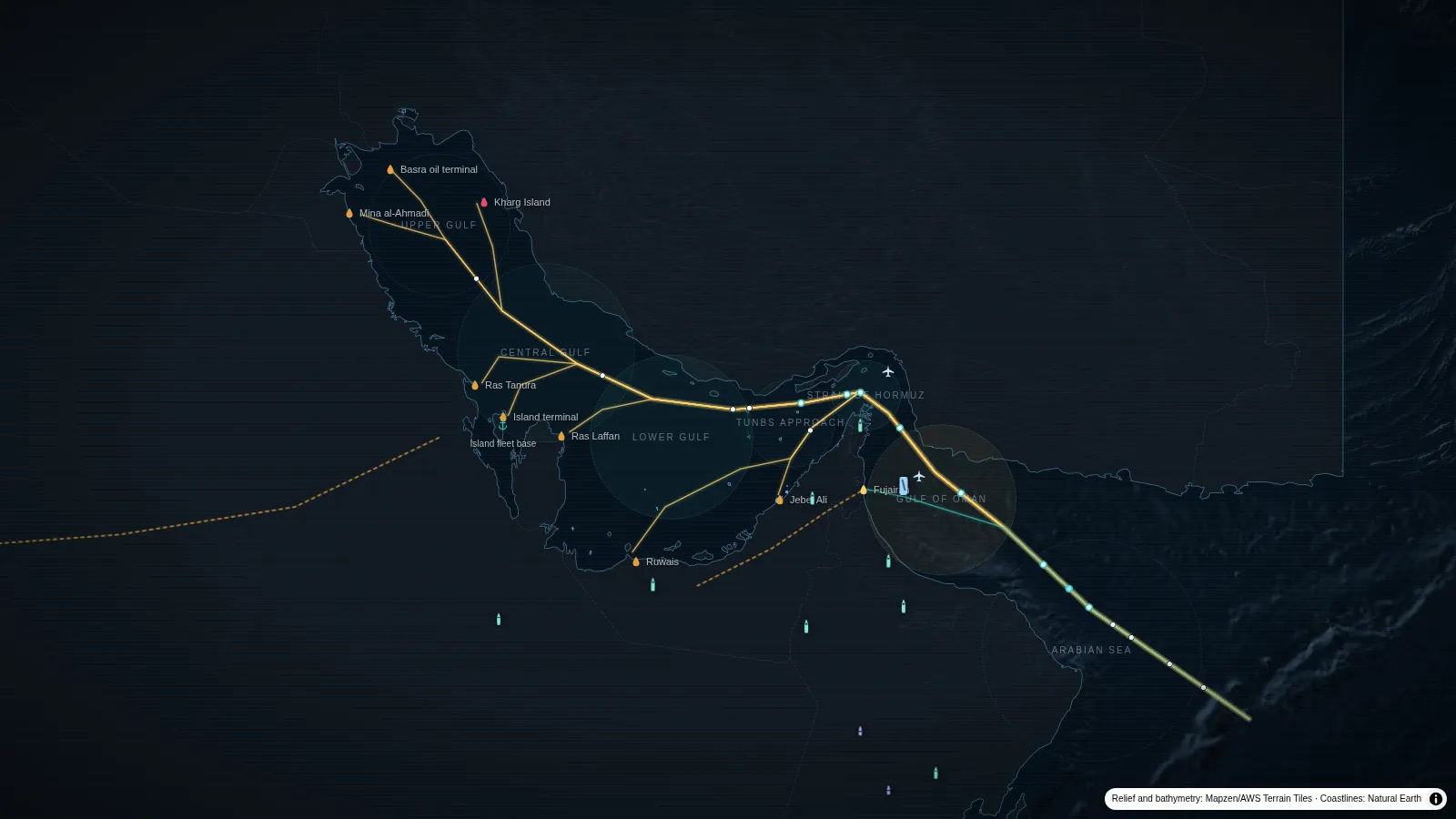
The northern shore has closed the Strait of Hormuz. Mines are in the shipping lanes, drones are in the air and a fifth of the world's oil is stuck in port. You command the coalition task force. The only score that matters is the price of a barrel.
A one-way attack drone costs about $35,000. The missile that stops it costs up to $2 million, and your destroyers have to leave station to reload. Every choice trades firepower, money, time and the patience of the public at home.
The traffic separation scheme between Larak and Musandam, the Tunbs, Kharg, Ras Tanura, Fujairah and Yanbu. Every lane is checked against real coastlines.
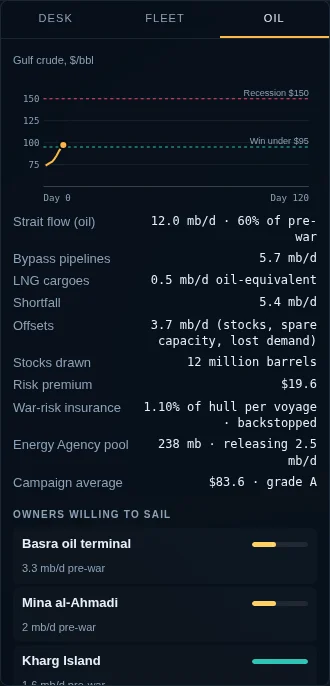
Lost barrels, emergency stocks, spare capacity, insurance premiums and demand that falls as prices rise. Lose 13 million barrels a day and you'll see $120 inside two weeks.
Your interceptors, fuel and mine hunters are finite. So are the enemy's missiles, boats and mines, and their launch sites can be found and struck.
Tankers don't move because you say so. They move when the risk falls and the escorts are there. Reinsure the war risk and more of them will try.
Stop the clock and build a joint strike: carrier aircraft, fighters from partner bases, stealth bombers out of Diego Garcia, cruise missiles and a special-forces raid. See the odds, then set H-hour.
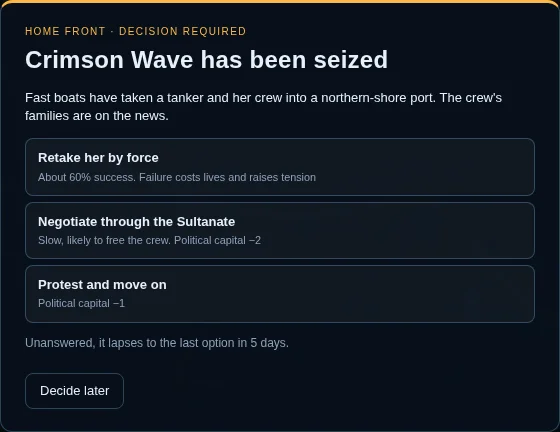
The Kingdom wants air defence for its terminal. The Great Eastern Importer wants its own deal. The Sultanate offers talks. Each one costs you something.
Formal radio traffic from your ships and the operations centre, a modern score that tightens as the crisis escalates, and the hum of the room behind it all.
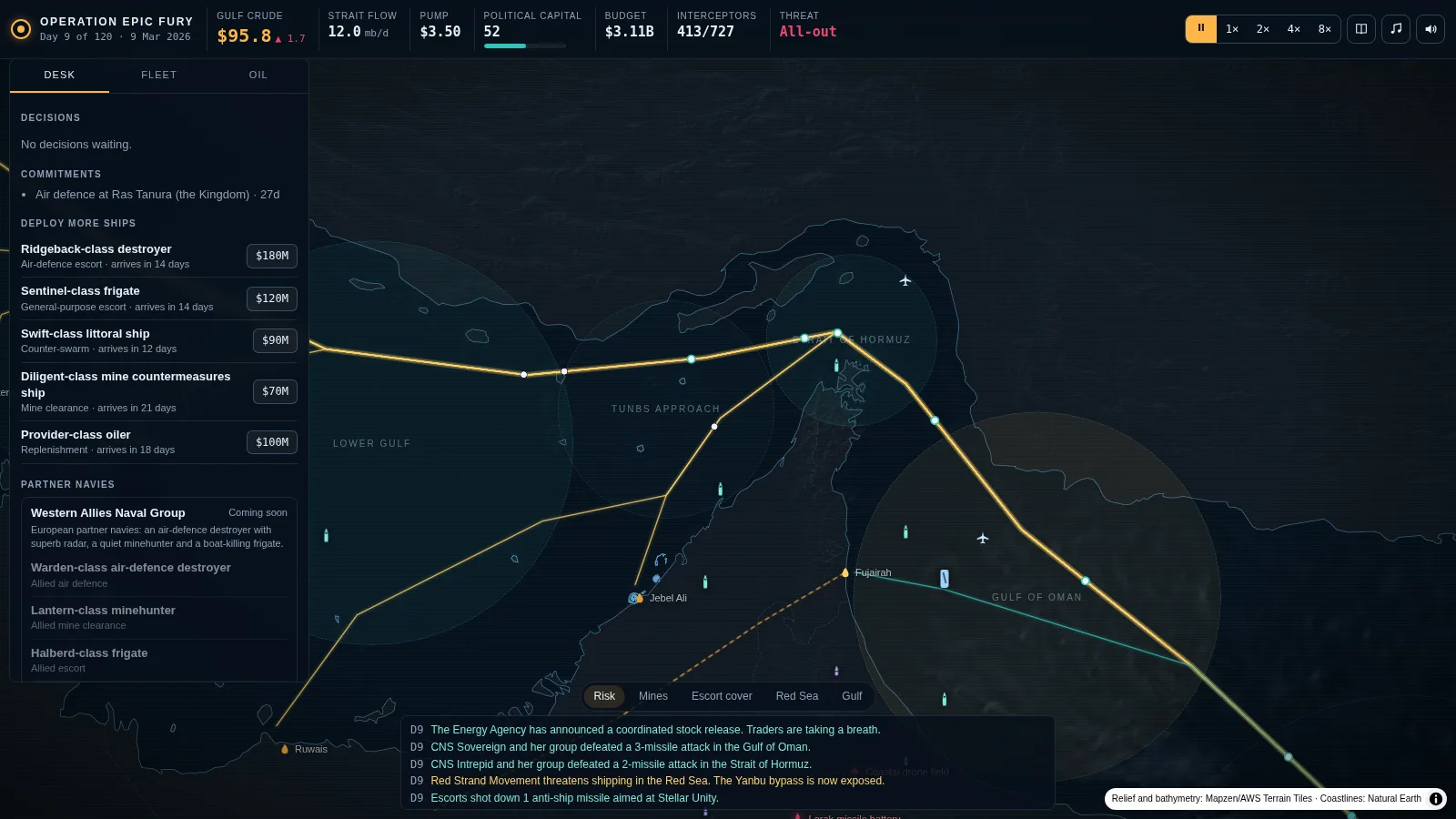
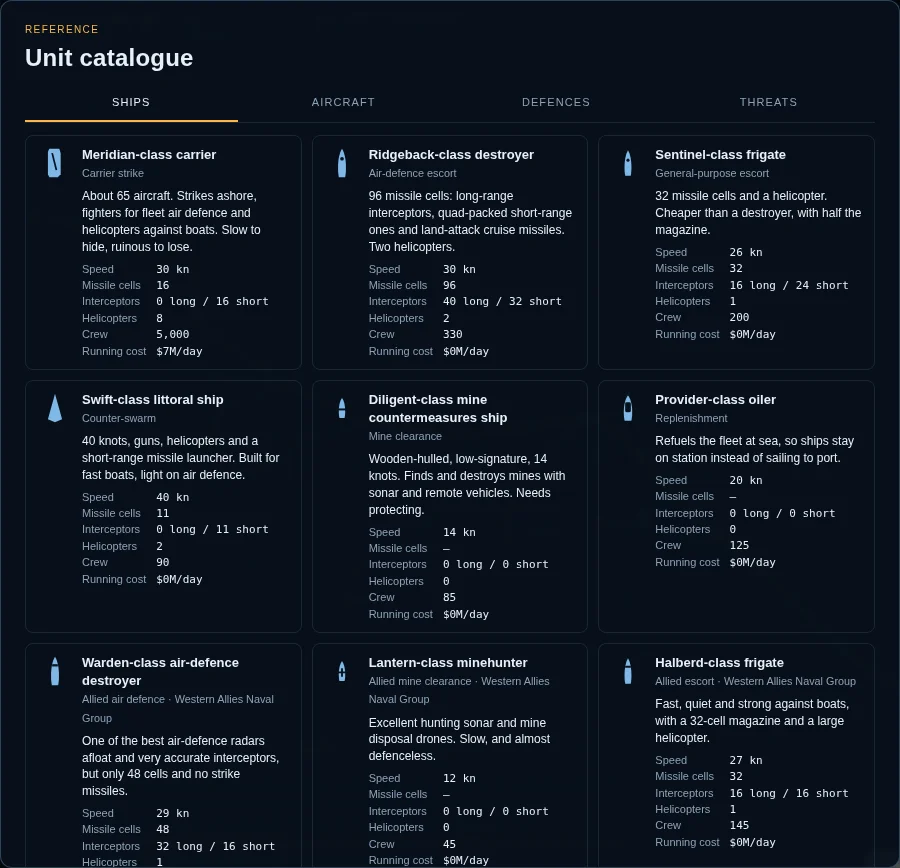
Class names are fictional. The numbers aren't. Magazine sizes, speeds, interceptor ranges, kill chances and costs are close to the real systems each class stands in for, taken from public sources. The full catalogue is in the game.
About 65 aircraft for strikes ashore and fleet defence. Your most powerful asset and the one you can least afford to lose.
96 missile cells each. Two long-range interceptors go up for every incoming missile, so magazines empty faster than you'd think.
Wooden-hulled, slow and vulnerable. They're also the only way to make the lanes safe again, ceasefire or not.
Optional packs add partner ships as reinforcements: the Western Allies Naval Group, the Island Economies Escort Flotilla with its mine-hunting helicopter carrier, and the Subcontinent Task Group. Each class trades a strength for a weakness. None of them is a shortcut.
The first three weeks of the campaign are free. The full campaign is a one-time unlock, with no ads and nothing that buys an advantage.
It's a strategy game, not a simulator. The oil market is a simplified model tuned to behave plausibly, not a forecast. Combat is resolved statistically rather than shot by shot. The conflict that inspired it was still going on when the game was made, so every faction, nation, person and ship in it is fictional.
Take command